
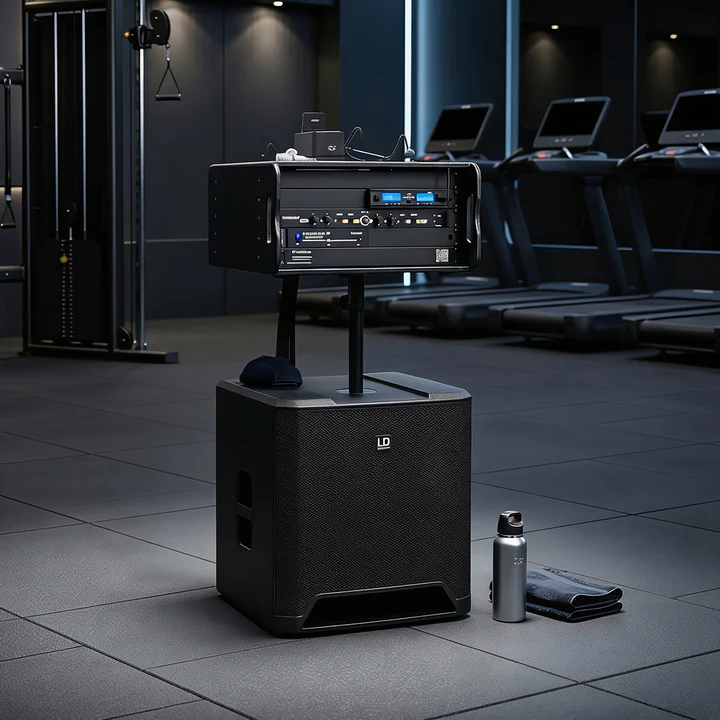
A fitness studio sound system has a fairly demanding job.
It needs to reproduce music with enough level and impact for the class, while keeping the instructor’s voice clear and intelligible over the top. It may run for hours every day, be operated by numerous instructors and, in many clubs, receive considerably less gentle treatment than most professional audio equipment.
So choosing a fitness studio sound system isn’t simply about buying powerful speakers or comparing amplifier wattages.
The microphone, wireless system, mixer, amplification and loudspeakers all need to work together, and the system needs to suit the room and the classes taking place in it.
Start with the studio, not the equipment
Two studios of similar size can require very different sound systems.
Room shape, ceiling height, construction, acoustics and loudspeaker positions all affect the result. So does the type of class.
A large Group Exercise studio running high-energy classes has different requirements from a Pilates or yoga studio. A dedicated cycle studio presents another set of challenges, particularly when it comes to instructor microphones and sweat.
Before choosing equipment, we want to understand what the room is being used for and what the system actually needs to achieve.
Clear instructor voice is essential
One of the most common complaints we hear is that instructors can’t get their microphones loud enough without feedback.
Turning everything up isn’t necessarily the answer.
The headset microphone, wireless system, mixer settings, loudspeaker position and the instructor’s position within the room all affect how much usable microphone level can be achieved.
A purpose-built fitness headset is particularly important. Fitness microphones have to cope with sweat, movement, cable stress and repeated adjustment, especially when they’re shared between instructors.
For commercial studio use, the EMic and Aeromic are both purpose-built fitness microphones. Which we recommend depends on how the microphone will be used, the teaching environment and whether it belongs to an individual instructor or is shared across a studio team.
But if a studio repeatedly suffers from low microphone level or feedback, we don’t assume that fitting another headset will solve it. Sometimes the microphone is simply exposing another problem within the system.
Loudspeaker positioning matters
You can buy very good loudspeakers and still end up with a poor studio sound system if they’re installed in the wrong places.
We want good, even coverage across the area where members are exercising without creating unnecessarily loud areas or firing excessive sound back towards the instructor’s microphone.
This becomes particularly important when we’re trying to achieve plenty of instructor level over loud music.
More speakers aren’t automatically better, and neither are bigger speakers.
The right loudspeakers, correctly positioned and properly set up for the room, are what matter.
Don’t choose a system by watts alone
Power figures are easy to compare, which is probably why they’re used so often to sell sound equipment.
Unfortunately, they don’t tell you how loud a system will actually be or how well it will perform in a fitness studio.
Loudspeaker efficiency is a big part of this. Two loudspeakers receiving the same amplifier power can produce very different sound levels, simply because one converts that power into acoustic output more efficiently than the other.
Loudspeaker efficiency, maximum output, coverage, amplifier capability and the way the system has been configured all matter.
A well-designed system should have enough clean output and headroom for the room without constantly being driven to its limit.
We’re much more interested in what the complete system can actually deliver in the studio than the biggest wattage number printed on the box.
The mixer should make life easier
A studio mixer shouldn’t require every instructor to become a sound engineer.
In day-to-day use, instructors generally need straightforward control of their microphone and music levels. The important system settings should already have been established when the system was commissioned.
This is one reason we use purpose-designed fitness mixers such as the Aeromix 2+2. Controls that instructors need are accessible, while the overall system level can be set separately rather than being accidentally changed from one class to the next.
The easier the system is to operate correctly, the less likely somebody is to solve a problem by turning everything up.
Think about how the music gets into the system
The connection between the instructor’s music source and the studio system can easily be overlooked.
For years, a simple audio lead was the standard answer. We still encounter plenty of studios where worn sockets, damaged cables and adaptors are responsible for intermittent music or loss of one channel.
Bluetooth provides a convenient alternative, but commercial installations need more than simply adding a cheap domestic Bluetooth receiver.
We use the Aerolink Bluetooth receiver where appropriate because it is designed to become part of the installed system. Remote pairing controls and antenna options also mean the receiver itself doesn’t have to be somewhere instructors can interfere with it.
Whatever method is used, connecting a phone or tablet should be quick, reliable and straightforward.
Wireless microphone reliability matters
A radio mic that works perfectly while you’re standing beside the equipment rack isn’t much use if it drops out when the instructor moves across the studio.
Wireless reliability can be affected by frequency choice, interference, receiver position and the condition of the equipment.
And sometimes the fault is surprisingly simple.
On wireless systems using removable external aerials, damaged or missing aerials can seriously reduce range and reliability. They’re normally quick and inexpensive to replace, so in busy studios using these systems we recommend keeping spares on site and treating them as consumable items.
Before condemning a wireless microphone system, it’s worth checking the basics.
Protect the system from enthusiastic fingers
A fitness studio is a shared working environment.
If every instructor can alter every setting on the system, sooner or later somebody will.
Gain controls get moved, amplifier levels are changed and yesterday’s attempt to solve a quiet microphone becomes today’s feedback problem.
A properly commissioned system should leave instructors with the controls they genuinely need while protecting the settings they don’t.
That doesn’t mean making the system difficult to use. Quite the opposite.
The aim is that an instructor can walk into the studio, connect their music, switch on the microphone and teach.
Reliability and serviceability matter
Fitness studio equipment works hard.
When we’re specifying a system, we’re not only interested in how it performs on installation day. We also consider how easy it will be to maintain, what happens when something eventually fails and whether replacement parts and support are readily available.
Standardising equipment across several studios or sites can help too. Staff become familiar with the controls, compatible spares can be held and faults are generally easier to diagnose.
A slightly cheaper system isn’t necessarily better value if it becomes difficult or expensive to keep running.
A fitness studio sound system should work as a system
This is probably the most important point.
A good headset connected to a good wireless system, feeding a good mixer, amplifier and pair of loudspeakers doesn’t automatically produce a good fitness studio sound system.
The individual components have to be selected and configured to work together in that particular room.
That’s why, when we’re investigating poor sound, feedback, unreliable microphones or equipment failures, we look at the complete signal path rather than automatically replacing whichever component appears to be causing the problem.
Sometimes the answer is a new microphone.
Sometimes it’s moving or replacing a loudspeaker, correcting the gain structure, repairing a wireless system or simply setting up the equipment properly.
And sometimes the studio really does need a new sound system.
Pulse Sound & Vision has been designing, supplying and installing professional audio systems for gyms, health clubs and fitness studios across the UK since 2008.
If you’re planning a new studio, upgrading an existing system or trying to solve a problem with the one you’ve already got, talk to us about the room and how it’s being used. We can help work out what actually needs changing before you start replacing equipment.