
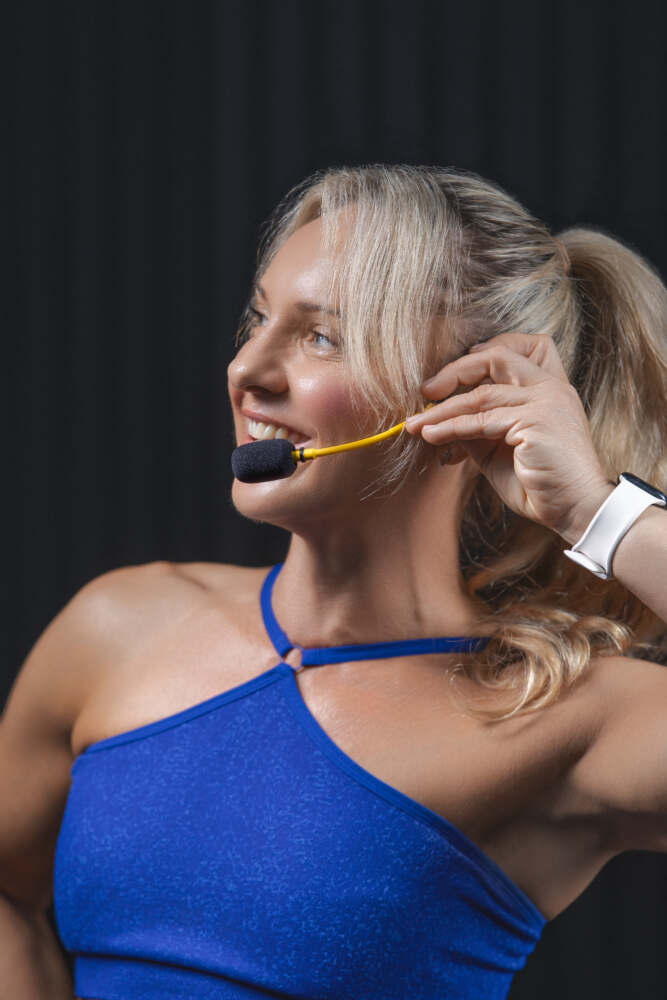
There are plenty of headset microphones sold for fitness.
We regularly come across Shure SM31FH, Trantec SJ66 and SJ33 headsets in studios, along with models from Sennheiser, AKG, LD Systems and others.
So the question isn’t whether you need a headset microphone designed for fitness.
It’s what makes one fitness headset better suited to the job than another.
That’s where the EMic comes in.
The EMic has been designed specifically around the things that make life difficult for headset microphones in fitness use: sweat, constant movement, cable stress and, particularly in a shared studio, repeated handling by different instructors.
Sweat protection isn’t just about the microphone capsule
Fitness microphones get wet. There’s no getting away from it.
Several of the fitness headsets we encounter have some form of moisture protection, and different manufacturers tackle the problem in different ways.
With the EMic, the approach goes beyond the capsule.
It uses a waterproof noise-cancelling capsule, a sealed and reinforced frame, steel cable and sweat protection around the connection.
That matters because the capsule isn’t the only potential point of failure. In real studios we see problems with cables, connections, frames and plugs as well as microphone elements.
No fitness headset is indestructible and even a purpose-built microphone still needs looking after. But if we’re choosing a headset specifically for regular Group Exercise use, we want the whole thing to have been designed with that environment in mind.
Durability matters, particularly in a shared studio
An individually owned microphone and a studio microphone can lead very different lives.
An instructor who owns their headset generally knows how it’s been used, how it’s stored and whether it’s been allowed to dry properly.
Put a microphone into a busy shared studio and it may be used by several instructors in a day, adjusted repeatedly, plugged and unplugged, put away and then picked up again for the next class.
That’s why we pay as much attention to the construction of a fitness headset as we do to its sound.
The EMic uses a reinforced frame and steel cable to improve durability in exactly this sort of environment.
It still has to sound good
Making a headset tougher isn’t much use if the instructor doesn’t sound good through it.
A fitness instructor’s voice needs to remain clear and intelligible over music at relatively high levels, while giving us enough control to achieve useful volume without constantly fighting feedback.
This is an area where we’ve found noticeable differences between fitness headsets.
The EMic uses a noise-cancelling capsule designed for the fitness environment and gives us a clear instructor voice through a properly set-up studio system.
That last part matters.
Changing the headset won’t cure every microphone problem. Poor gain structure, an unsuitable wireless system, loudspeaker positioning and the way the studio sound system has been configured can all affect the result.
How does EMic compare with other fitness microphones?
There isn’t a single answer because the alternatives aren’t all the same.
The Shure SM31FH, for example, is a genuine fitness headset with moisture-resistant construction. Trantec’s SJ66 is also designed specifically for fitness applications.
We encounter both regularly in commercial studios.
Our preference for EMic isn’t based on pretending those products aren’t fitness microphones. It’s based on the combination of construction, sweat protection, sound quality and cost that we’ve found works particularly well for Group Exercise.
It’s why EMic has become our usual starting point when we’re replacing a fitness headset or specifying a new wireless microphone system for a studio.
Will an EMic work with my existing wireless system?
In many cases, yes. And this is another area where EMic is a little different.
EMic uses the world-first MultiMic connection. Put simply:
If the EMic plug fits, it will work.
The T4 MultiMic works with brands using the T4 connector, including Fitness Audio, Shure, Chiayo, Mipro, TOA, JTS, EV and Telex.
The T3 MultiMic works with brands using the T3 connector, including AKG, Samson, Redback and Okayo.
This means you’re not necessarily tied to replacing a failed headset with another one from the manufacturer of your wireless system.
If your Shure SM31FH needs replacing, for example, the appropriate T4 EMic can plug directly into a compatible Shure bodypack. You can keep your existing wireless system and choose EMic as the replacement headset.
Likewise, if you have a compatible AKG system using a T3 connection, the T3 EMic gives you another headset option without replacing a perfectly serviceable wireless system.
MultiMic can also be particularly useful for instructors working across different studios. The same T4 EMic can, for example, be used with a Fitness Audio transmitter in one studio and a compatible Shure transmitter in another.
If you’re not sure which connection you have, send us a photograph of your bodypack transmitter and microphone socket. We can usually identify what you need very quickly.
Is EMic the right choice for every instructor or studio?
Not necessarily.
EMic is designed for light-to-medium and regular studio use, recommended for up to 20 non-consecutive classes per week. It carries a 12-month warranty against malfunction caused by sweat damage when used within the specified conditions.
For many instructors and studios, that gives a very good balance of sound quality, durability and cost.
For an instructor with a particularly heavy teaching schedule, we’d look further up the range at Aeromic, which is designed for considerably heavier professional fitness use and carries its two-year No Sweat Warranty under the specified usage conditions.
Usage matters.
So does whether the microphone belongs to one instructor or is shared by an entire studio team.
That’s why we’ll usually ask how a microphone is going to be used before recommending one.
Choosing a fitness microphone for a commercial studio
For us, the headset is only one part of the system.
We look at the headset, transmitter and receiver, mixer, amplification and loudspeakers together. If instructors are struggling to get enough level, suffering from feedback or repeatedly getting through microphones, it’s worth finding out why before simply buying another headset.
Pulse Sound & Vision has been designing, supplying and installing sound systems for health clubs and fitness studios across the UK since 2008.
If you’re replacing a failed fitness headset, upgrading an existing wireless microphone system or simply aren’t sure what will work with the equipment you already have, get in touch and we’ll help you work out the right option.
And if you’re repeatedly having microphone problems in the same studio, it’s worth talking to us before buying another one. The headset may not be the problem.
Frequently asked questions
Can I use an EMic with a Shure wireless system?
Yes. The T4 MultiMic version is compatible with Shure bodypack transmitters using the corresponding T4 connection. If your existing Shure headset needs replacing, you may be able to keep the transmitter and receiver and simply change the headset.
Can I use an EMic with an AKG wireless system?
The T3 MultiMic version is compatible with AKG systems using the corresponding T3 connection. If you’re unsure which connection your system uses, send us a photograph of the bodypack and we’ll check it for you.
Is the EMic suitable for fitness instructors?
Yes. EMic is designed specifically for fitness use and is recommended for up to 20 non-consecutive classes per week.
What’s the difference between EMic and Aeromic?
Both are purpose-built fitness headset microphones. EMic is our usual choice for light-to-medium and regular studio use, while Aeromic is designed for considerably heavier professional fitness workloads and carries a two-year No Sweat Warranty under its specified usage conditions.